
Portable data could make affordable housing easier to navigate. But what happens when “verified” information begins traveling with us?
Executive Read · 2–3 minutes
By Shauna Visser
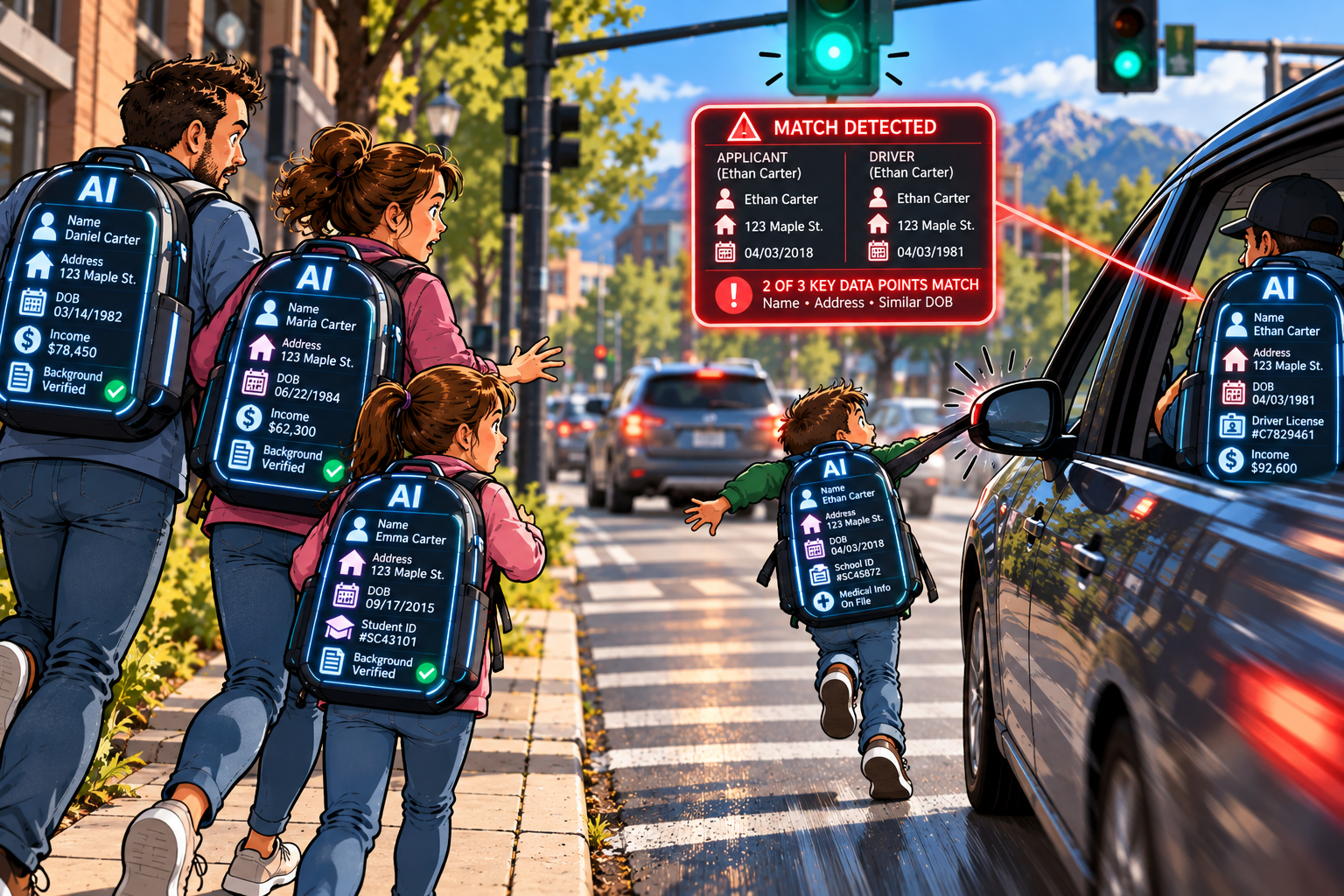
Maybe I’ve watched too much Black Mirror, because when I first heard the words “digital backpack,” I had two almost simultaneous reactions: That’s brilliant. And that sounds suspiciously like the beginning of a Black Mirror episode.
In September, KPCW reported that the Summit County Housing Authority approved a one-time $25,000 grant to Mountainlands Community Housing Trust toward developing a centralized affordable-housing application for Utah’s Wasatch Back. Mountainlands plans to work with local startup One Door Home, and Executive Director Jason Glidden described the concept as a “digital backpack.”
The appeal is obvious. Affordable-housing applicants repeatedly provide many of the same bank statements, paystubs, identification and employment information. I’ve seen the value of portability in my own compliance work. We’ve had households exceed the income limit at one property but qualify at another and allowed their documentation to move with them within our portfolio rather than making them start over.
I’m all for easier. But I keep coming back to one word: verified.
In my compliance work, I have held a Work Number report in one hand and the corresponding paystubs in the other and found that the information did not reconcile. That doesn’t make The Work Number inherently unreliable. Large information systems can contain outdated information, errors or records that require explanation. It does remind us that a record carrying the label “verified” may still require clarification or correction.
Today, a reviewer looking at conflicting records can stop and investigate. But what happens when the next organization never sees the underlying documents and instead receives a portable record that simply says:
Income: $41,742, VERIFIED
If it’s correct, that could be wonderfully efficient. If it isn’t, does portability make the correction portable too, or just the error?
There is another side to the problem. What happens when a system can’t verify someone? Maybe the applicant is self-employed, works multiple jobs or simply falls outside a particular verification network. “Unable to verify” doesn’t mean “not true.” But if automated verification becomes the faster path, it can create two very different experiences: applicants the system can readily verify and applicants who require additional review.
Nobody necessarily intended to create two classes of applicants. One route was simply easier. But housing providers should probably pay attention to who consistently ends up in the slower line.
HUD has warned that automated tenant-screening systems can produce unjustified discriminatory effects even when protected characteristics are not explicitly used. Meanwhile, FDIC data show that access to mainstream banking remains uneven. In 2023, 10.6% of Black households, 9.5% of Hispanic households and 12.2% of American Indian or Alaska Native households were unbanked, compared with 1.9% of White households. Higher unbanked rates also appear among lower-income households, working-age households with disabilities and households with volatile income.
That does not show that digital verification disadvantages those groups. It does show that access to some of the financial infrastructure increasingly available to digital systems is not evenly distributed. That makes it worth testing who an automated process sees easily, who requires additional review and what happens to each group.
Now imagine a digital housing passport becomes exceptionally reliable and widely accepted. “Passport accepted” becomes “Passport expedited.” Eventually, could it become “Passport preferred”?
This is a thought experiment, not a description of what One Door Home is building. But it raises an interesting question: At what point do we stop asking what is in the backpack and start paying attention to which backpack someone carries?
The more consequential question may be who gets to stamp VERIFIED on what goes inside. Who decides which verification providers are trusted? What happens when they disagree? Is there another path when their information is wrong, or when they simply cannot see someone?
None of this is what Summit County, Mountainlands or One Door Home has said it is building. A centralized application could solve very real problems for people navigating affordable housing. The point isn’t to turn one local project into a dystopian prediction. It’s to notice how infrastructure gets built.
Electronic verification makes sense. Portability makes sense. Standardization makes sense. Automation makes sense. Each decision can be perfectly rational.
And twenty rational decisions later, we can still reasonably look around and ask:
What exactly did we build?
Maybe I have watched too much Black Mirror. Or maybe these are exactly the questions we should be asking before the next episode starts.
Want to go deeper?
Sources
KPCW, Connor Thomas, “Park City locals building digital tool to streamline affordable housing applications,” September 22, 2026.
U.S. Department of Housing and Urban Development, “Guidance on Application of the Fair Housing Act to the Screening of Applicants for Rental Housing,” April 29, 2024.
Federal Deposit Insurance Corporation, “2023 FDIC National Survey of Unbanked and Underbanked Households.”
Equifax, The Work Number, Employment Data Report and Employee Data Dispute resources.
Source verification: KPCW is the source for the local project description. HUD’s guidance specifically covers automated tenant screening, including machine learning and AI. The FDIC reports a 4.2% overall unbanked rate in 2023 and the demographic percentages used above. Equifax provides a formal process for consumers to dispute information in their Employment Data Reports.

