
The Deeper Exploration · 6–7 minutes
By Shauna Visser
The idea of portable housing information sounds straightforward until we ask what kind of information is actually being carried.
Take a bank statement. The statement itself is source evidence. Someone reviews it and records the balance; that is a fact derived from the evidence. Someone notices $600 appearing every month; that is an observation. Someone determines those deposits represent recurring income; that is a conclusion. A housing program applies its rules and reaches an eligibility determination; that is a decision.
An AI reviewing the same statement might produce something else: an inference.
Those things are connected, but they are not interchangeable.
Imagine the applicant’s portable record eventually says, “Recurring additional income: $600 per month.” Where did that statement come from? Did the applicant report a second job? Did an employer verify wages? Did a compliance specialist review the deposits? Did another housing provider make the determination under different program requirements? Or did software recognize a recurring pattern and decide it deserved attention?
Maybe the deposits were wages. Maybe they were transfers. Maybe someone was repaying money the applicant loaned them. Maybe Grandma was reimbursing them for something they purchased on her behalf.
The point isn’t to determine the answer from here. The point is that the answer has a history.
Affordable-housing compliance already deals with this problem. Information that doesn’t reconcile often requires clarification and additional documentation before someone can determine how it should be treated. That context becomes part of understanding why the final determination was made.
What happens when the determination travels but the context doesn’t?
A question can become an inference. The inference becomes a field in a database. The field moves into another system, and eventually the next person sees only the conclusion. Because it arrived from a trusted source, nobody thinks to ask whether it once started as a question.

There is a useful word for preserving that history: provenance. Where did the information come from? Who created it? When? Was it reported by the applicant, obtained from a third party, calculated, verified, inferred or determined under a particular set of rules?
That distinction matters in affordable housing because eligibility itself is not universal. Programs differ. Funding layers differ. Rules differ. Effective dates matter. A determination made correctly for one purpose does not automatically become a permanent fact about a household.
The problem becomes even more interesting when the original information was supposedly verified.
In my compliance work, I have held a Work Number report in one hand and the corresponding paystubs in the other and found that the information did not reconcile. Equifax provides consumers with a process to review and dispute employment information contained in The Work Number. That matters because information obtained from a large database can still require clarification or correction.
Portable verification therefore creates at least three possibilities: information is verified correctly, information cannot be verified, or something labeled verified later turns out to be incorrect.
The third deserves more attention than it usually receives.
When two documents are sitting in front of a human reviewer, the inconsistency is visible. If the underlying documents disappear from the next transaction and only the resulting verified field travels, the discrepancy may become invisible while the conclusion becomes more authoritative.
If verified information becomes portable, does the history of its correction travel too?
The opposite problem occurs when a system simply cannot see someone.
Digital verification works particularly well when information is structured, connected and available through participating systems. But people’s financial lives aren’t equally tidy. Someone may be self-employed, work several jobs, have volatile income or simply fall outside the data sources available to a particular verification system.
“Unable to verify” is not the same as “not true.”
The disparities surrounding financial access are measurable. FDIC’s 2023 household survey found an overall U.S. unbanked rate of 4.2%, but the rate was 10.6% among Black households, 9.5% among Hispanic households, 12.2% among American Indian or Alaska Native households and 1.9% among White households. The FDIC also found higher unbanked rates among lower-income households, households with substantial month-to-month income variation and working-age households with disabilities.
That does not establish that a digital housing passport would discriminate against those populations, nor does every verification system depend on bank-account data. It tells us something more useful: access to some of the financial infrastructure available to digital systems is not evenly distributed.
HUD has already warned housing providers that using third-party screening systems, including systems incorporating artificial intelligence and machine learning, does not eliminate their responsibilities under the Fair Housing Act. Automated systems can still produce unjustified discriminatory effects.
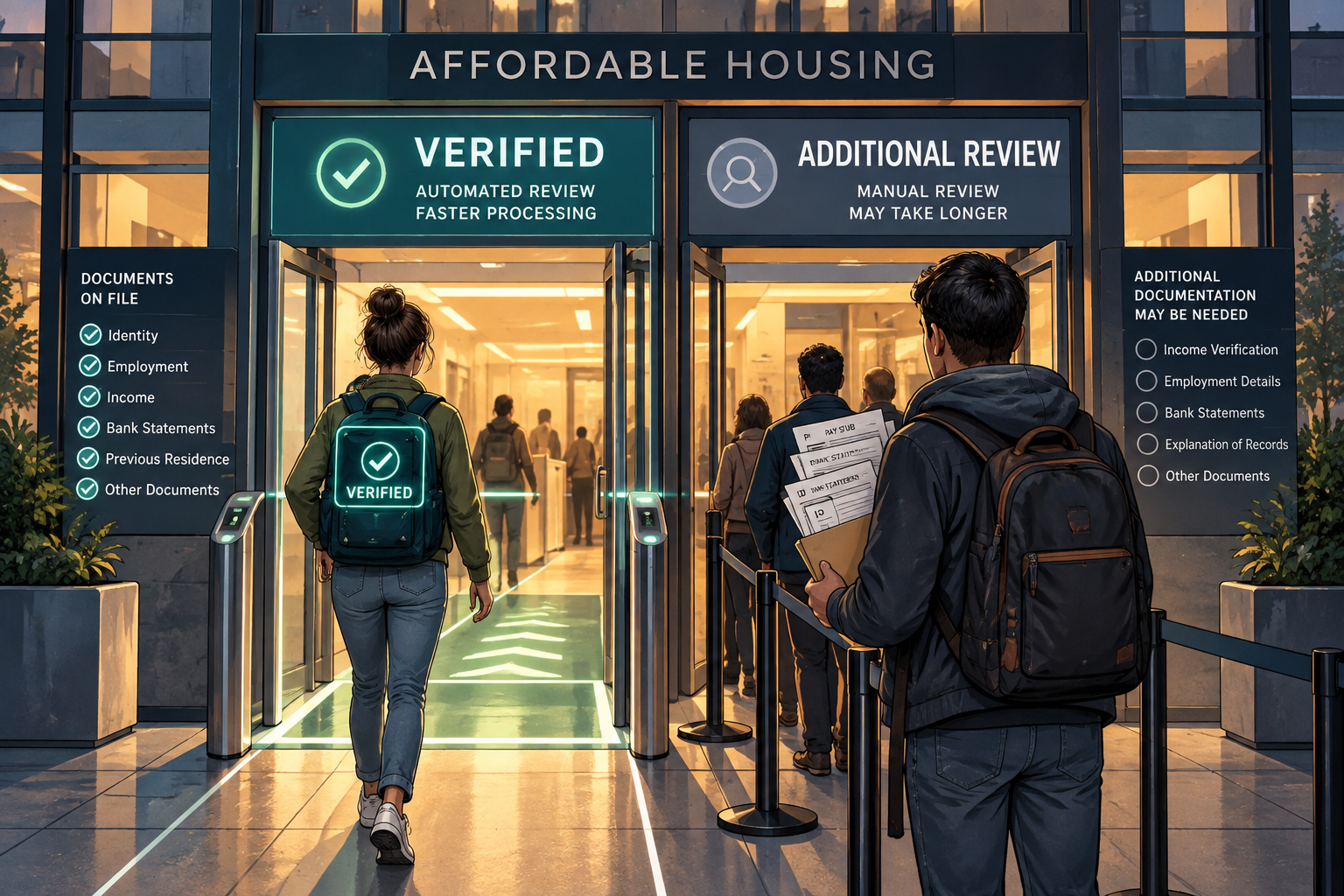
We already live with systems that create different lanes based on advance verification.
TSA PreCheck is a familiar example. It is a voluntary expedited-screening program for travelers who have gone through advance vetting. At participating checkpoints, eligible travelers generally don’t have to remove their shoes, belts or light jackets and can leave laptops and compliant liquids in their bags. Travelers using the standard screening lane go through more steps. Everyone is still subject to security screening; the process is simply different.
There is nothing inherently wrong with that distinction. In fact, it can make the entire system more efficient.
But imagine that same logic applied to housing verification.
One applicant arrives carrying a credential the system already trusts. Another arrives carrying the documents needed to prove the same things. Both may be perfectly eligible.
One simply enters through a different lane.
One applicant connects immediately to recognized data sources. Identity found. Employment found. Income found. The application moves.
The second produces legitimate documentation, but the automated system cannot electronically match or confirm everything it expects. That application requires additional review.
Nothing discriminatory necessarily occurred. Nothing improper necessarily occurred. Manual review may actually protect the second applicant from a bad automated decision.
But if one lane consistently takes seconds and another takes days, it becomes worth measuring who repeatedly ends up in each lane and what happens to them once they do.
The accuracy of the match matters too.
Urban Institute researchers studying tenant-screening data have documented false positives, false negatives and ambiguous matches in the process of linking court records to individuals. Their research illustrates how decisions about whether records belong to the same person can materially affect a tenant-screening risk profile.
In a portable system, then, the important question isn’t only whether an error can occur.
It’s whether the error, or its correction, travels.
Now imagine Company X develops an excellent digital housing passport. Applicants like it because they stop repeatedly uploading the same documents. Housing providers like it because much of the information arrives already verified. More properties accept it, and Company X develops a reputation for reliable information.
“X Passport accepted” could become “X Passport expedited.”
Eventually, perhaps, “X Passport preferred.”
This is a thought experiment, not a description of the Wasatch Back project. But credentials have a tendency to acquire meaning beyond the information they originally certify. At some point, the question could shift from what is in the backpack to which backpack someone carries.
And that makes the authority to label something VERIFIED increasingly valuable.
Suppose a portable record says annual income is $41,742 and verified. Verified by whom? From which source? How recently? Can the applicant see what was used? Can another organization independently verify it? What happens when two sources disagree? Who determines which source wins?
As verification becomes more standardized, more of the process can potentially be automated. Employers, payroll systems, financial institutions, housing providers and government programs already participate in various forms of electronic data exchange and verification.
No one needs to announce the creation of a national income-verification infrastructure. Enough useful systems could become interconnected that something resembling one begins to emerge.
That is not a description of a national system operating today. It is a question about where widespread adoption and standardization could eventually lead.
Such infrastructure could produce tremendous efficiencies. It could also concentrate importance around the organizations capable of making information machine-readable, portable and trusted.
Then there are scores.
Tenant screening already uses algorithmic risk scores. Urban Institute research has noted that many screening companies use algorithmic models to assign tenant risk scores while relatively little public evidence demonstrates how accurately those scores predict rental outcomes.
A future digital identity system would not have to invent the idea of reducing complicated applicant information to a number. That machinery already exists.
AI could add another layer by identifying patterns or generating inferences from increasingly large sets of information. Employment, income, assets, credit, rental history, previous addresses and other records could become inputs. Patterns could become predictions, and complicated predictions have an irresistible tendency to become simpler numbers.
Imagine:
Housing Stability: 74.8
That number is fictional.
The idea of scoring renters isn’t.
What made someone a 74.8? A job change? Moving twice? A disputed record? Income volatility? Those recurring $600 deposits? Something another system concluded years earlier?
And if one of those inputs is corrected, does the correction propagate everywhere the original conclusion traveled?
There is another possibility. Maybe a digital backpack never contains a score at all.
Perhaps it doesn’t need one.
If a particular passport becomes widely trusted, simply possessing it could eventually function as a signal. Applicants carrying it move quickly. Applicants without it require additional verification. The passport itself begins communicating something before anyone examines its contents.
Then opting out becomes interesting too. If nearly everyone carries a trusted digital credential, does choosing not to carry one eventually communicate something even when it shouldn’t?
This is where the metaphor of the backpack starts bothering me.
Backpacks accumulate things: old receipts, things we forgot were there, things somebody else put inside, information that was useful six months ago and probably should have been discarded.
Maybe the better metaphor for portable digital identity is something closer to a key ring, where different information requires different permissions and the person carrying the keys understands which doors they open.
Whatever these systems ultimately look like, there is a meaningful difference between carrying evidence about a person and carrying someone else’s conclusion about that person.
There is an even more interesting difference when the conclusion was produced or influenced by a machine.
Someone still has to decide what the machine should notice, which inconsistencies matter, which patterns deserve attention and what “risk” looks like in the first place.
An AI didn’t wake up one morning and decide that three $600 deposits were interesting.
Somewhere along the way, it learned to look there.
And that is where the next question begins:
Who taught the machine what to look for?
Sources
KPCW
Connor Thomas, “Park City locals building digital tool to streamline affordable housing applications,” September 22, 2026.
Use for: Wasatch Back project, Summit County Housing Authority grant, Mountainlands Community Housing Trust, One Door Home and “digital backpack” description.
Federal Deposit Insurance Corporation
“2023 FDIC National Survey of Unbanked and Underbanked Households.”
Use for: national unbanked rate and demographic differences in access to banking. The FDIC confirms the 4.2% overall rate and the 10.6%, 9.5%, 12.2% and 1.9% figures used in the article.
U.S. Department of Housing and Urban Development
“Guidance on Application of the Fair Housing Act to the Screening of Applicants for Rental Housing,” April 29, 2024.
Use for: Fair Housing Act application to third-party tenant screening, automated screening, machine learning and artificial intelligence. HUD states that housing providers and tenant-screening companies must comply with the Fair Housing Act and addresses practices with unjustified discriminatory effects.
Urban Institute
Judah Axelrod, Brendan Chen, Katie Fallon and Sonia Torres Rodríguez, “Opening the ‘Black Box’ of Tenant Screening: Analyzing Data Matches in Court Data,” March 25, 2025.
Use for: false positives, false negatives, ambiguous matches, lack of unique identifiers and the effect of data-matching assumptions on tenant-screening information. Urban found that risk profiles could be highly sensitive to decisions about whether records belonged to a particular individual.
Urban Institute
Adriana Vance, Judah Axelrod, Katie Fallon, Rebecca John and Evy Park, “Modeling How Tenant Screening Policies Shape Housing Access,” August 26, 2026.
Use for: algorithmic tenant risk scores and the limited public evidence regarding how accurately those scores predict rental outcomes. Urban specifically reports that many companies have developed algorithmic models assigning tenant risk scores and that little public evidence demonstrates their predictive accuracy.
Equifax, The Work Number
Employment Data Report and Employee Data Dispute resources.
Use for: ability of consumers to review and dispute employment information contained in their Employment Data Report. Equifax’s dispute documentation specifically provides a process for disputing fields in an Employment Data Report.
Transportation Security Administration
TSA PreCheck program and checkpoint guidance.
Use for: TSA PreCheck analogy. TSA describes PreCheck as a voluntary expedited screening program and confirms that PreCheck travelers generally do not need to remove shoes, laptops, compliant liquids, belts or light jackets.

