
By Shauna Visser

After writing about what happens when real estate starts thinking, I kept thinking about the person selling it. We spend a great deal of time imagining what a sophisticated buyer might do with better information. Somewhere in that conversation, the homeowner seems to disappear. She is still at the kitchen table, looking at an offer, trying to decide whether it is a good one.
Imagine the offer is $425,000. The comparable sales support it. Her realtor has walked her through the market, and the number is close to what she expected. She could accept it, pay off the mortgage and have enough left for the next place. So far, this looks like an ordinary transaction, with two people arriving at a price they can both live with.
Now suppose the buyer has been looking at something else as well. Alongside the comparable sales is an analysis of employment, construction, infrastructure and changes in the surrounding market. The buyer’s model suggests that this neighborhood has a better chance of appreciating than several others under consideration. Nothing is guaranteed, but the combination is interesting enough to help explain why this particular offer landed on this particular kitchen table.
I’m imagining that transaction, not reporting one. But it leaves me with a question I can’t quite put down: what if the seller had the same crystal ball?
Anyone who has worked in real estate could reasonably point out that people have been doing this for years. Of course they have. A good realtor notices when listings start moving faster. A developer follows a proposed road long before there is pavement. An investor pays attention when an employer starts hiring. Experience gives those observations meaning, and I wouldn’t dismiss that experience simply because a computer has entered the room wearing a very expensive name tag.
What interests me is how much more information might now fit into that room. A person can know a market exceptionally well and still have limits on what she can follow. There are only so many planning meetings, employment reports and development applications anyone can read before somebody needs dinner. A system that helps connect those sources could give an experienced professional more to work with, including relationships she might otherwise have missed.
There is already research behind part of this. Zillow’s published forecasting methodology describes using national and local indicators to estimate home-price appreciation, with forecasts extending to ZIP codes. That is different from knowing what will happen to the house with the blue front door. It does, however, give us a place to begin asking how increasingly detailed forecasts might influence the people buying and selling that house.
I’m less persuaded by the decimal point. Tell me a neighborhood looks promising and I have questions. Tell me there is a 74.8 percent probability of appreciation and, for a moment, I want to know where to sign. Apparently the extra eight-tenths has done something to my judgment. Yet that number would still need a definition: appreciation over what period, by how much, under which assumptions? In this example it is an invented number, chosen to illustrate how convincing precision can look. An actual forecast would need considerably more explanation than a thermometer and a confident expression.
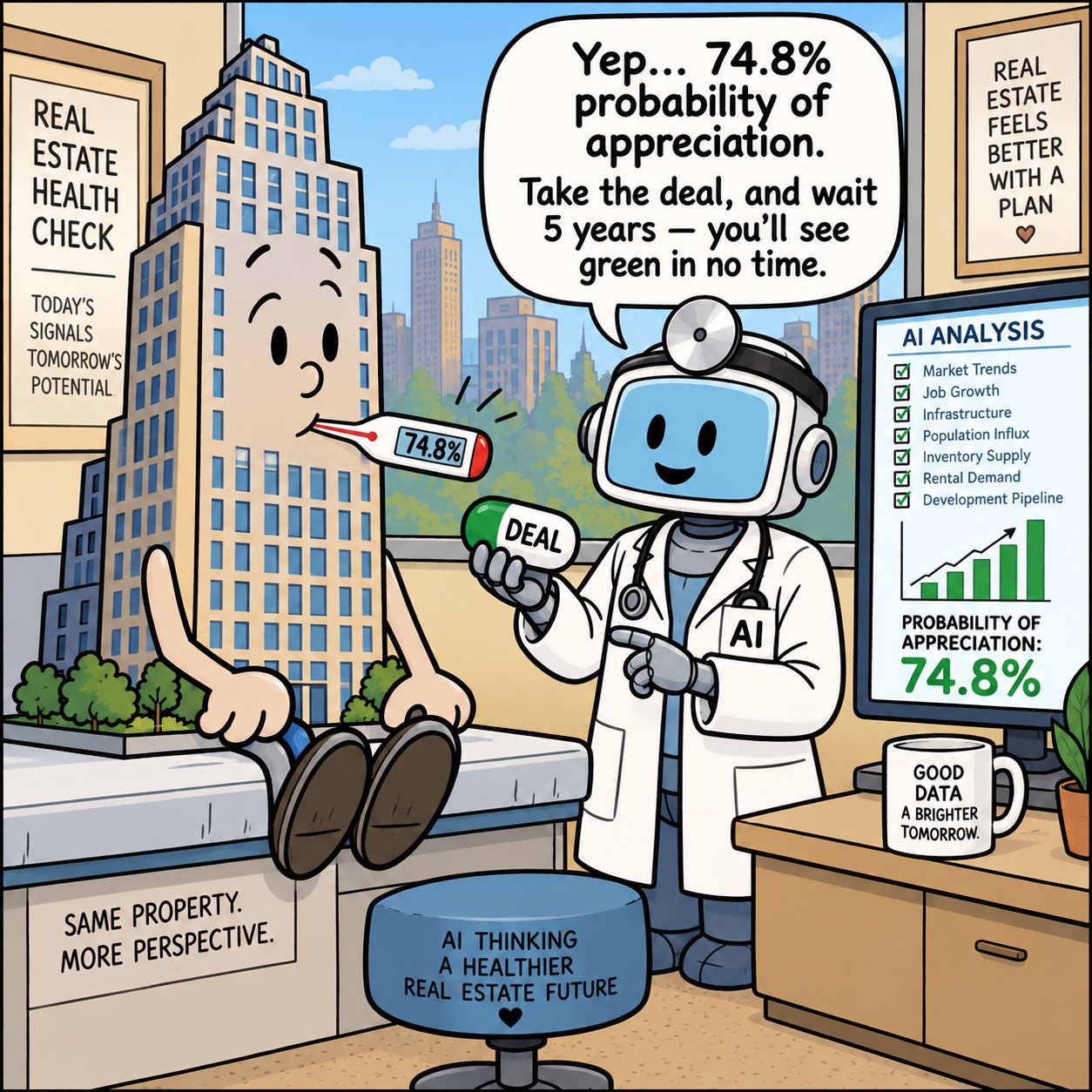
Illustration: 74.8% is a hypothetical probability, not an actual property forecast.
Even a carefully built model has to contend with a world that keeps changing its plans. The employer may cancel the expansion. The road may spend another decade being discussed. Insurance costs may change the economics of owning the property. The homeowner’s decision to sell might turn out to be excellent. I don’t think we need to pretend uncertainty has disappeared to be interested in who has the better tools for examining it.
That brings me back to the $425,000 offer. The seller may be getting a fair price for the property in today’s market. The buyer may be taking a sensible risk on what could happen next. I can understand both decisions. What I want to know is whether the seller had a reasonable opportunity to consider the information that made the buyer interested in the first place.
It’s easy to turn that question into an argument about investors behaving badly, which would let the rest of us off far too easily. Researching an investment is what we expect a buyer to do. The more useful question concerns access. If better analysis becomes expensive enough that it makes sense mainly for someone buying hundreds of properties, where does that leave the person selling one?
The U.S. Government Accountability Office’s 2024 report on institutional investment in single-family homes describes how technological advances helped companies acquire and manage large portfolios. It doesn’t establish that an investor can reliably predict the future value of an individual home. It does show why technology belongs in this conversation: it can change the scale at which a buyer is able to operate.
And scale changes the consequences of being wrong. An investor can lose money on one property while doing well across the rest of a portfolio. A homeowner may have decades of savings tied to the transaction sitting in front of her. She cannot average her result across another nine hundred and ninety-nine houses. If better information would have changed her decision, that matters even if the sale price was entirely defensible.
Homeowners already have access to valuation tools and market information that would once have been much harder to obtain. I wonder what the next useful step would look like. Perhaps a seller could see which nearby changes a model considered significant, how similar circumstances had played out elsewhere, and where the comparison became unreliable. Her realtor could help her weigh that against what was happening on the ground. She could ask why an employer’s announcement mattered so much, or whether a proposed development was being treated as though it had already been built.
The homeowner would have something to contribute too. She knows the basement gets wet in April. She knows the school people ask about at every open house, and the intersection nobody wants to turn left at after four. Some of that may eventually appear in a dataset. Some of it will need a conversation. I would like to see what happens when the information travels in both directions, rather than assuming the person with the software has finished the thinking for everyone.
That is the kind of tool I would want at the kitchen table: something I could question, with enough explanation to help me decide how much weight to give its answer. I’m not looking for an AI oracle telling us what to do.
Our seller might examine all of it and accept the same $425,000. Perhaps she is moving closer to her children. Perhaps holding the house would mean carrying costs or risks she doesn’t want. A possible gain in three years may be less valuable to her than being able to move this summer. Better information should leave room for that judgment. Otherwise we have simply given her another authority to argue with.
But she might also pause. She might ask a different question, seek another opinion or decide the offer deserves a closer look. That possibility is what keeps bringing me back to the seller. As we build increasingly sophisticated ways to recognize opportunity in someone’s property, I would like the person who owns it to have a chance to recognize it too. Before she hands over the keys.

