
INNOVATION + INTELLIGENCE · 8–9 MIN READ
Real estate has always been about location. But what happens when technology gets better at understanding location than we are?
By Shauna Visser
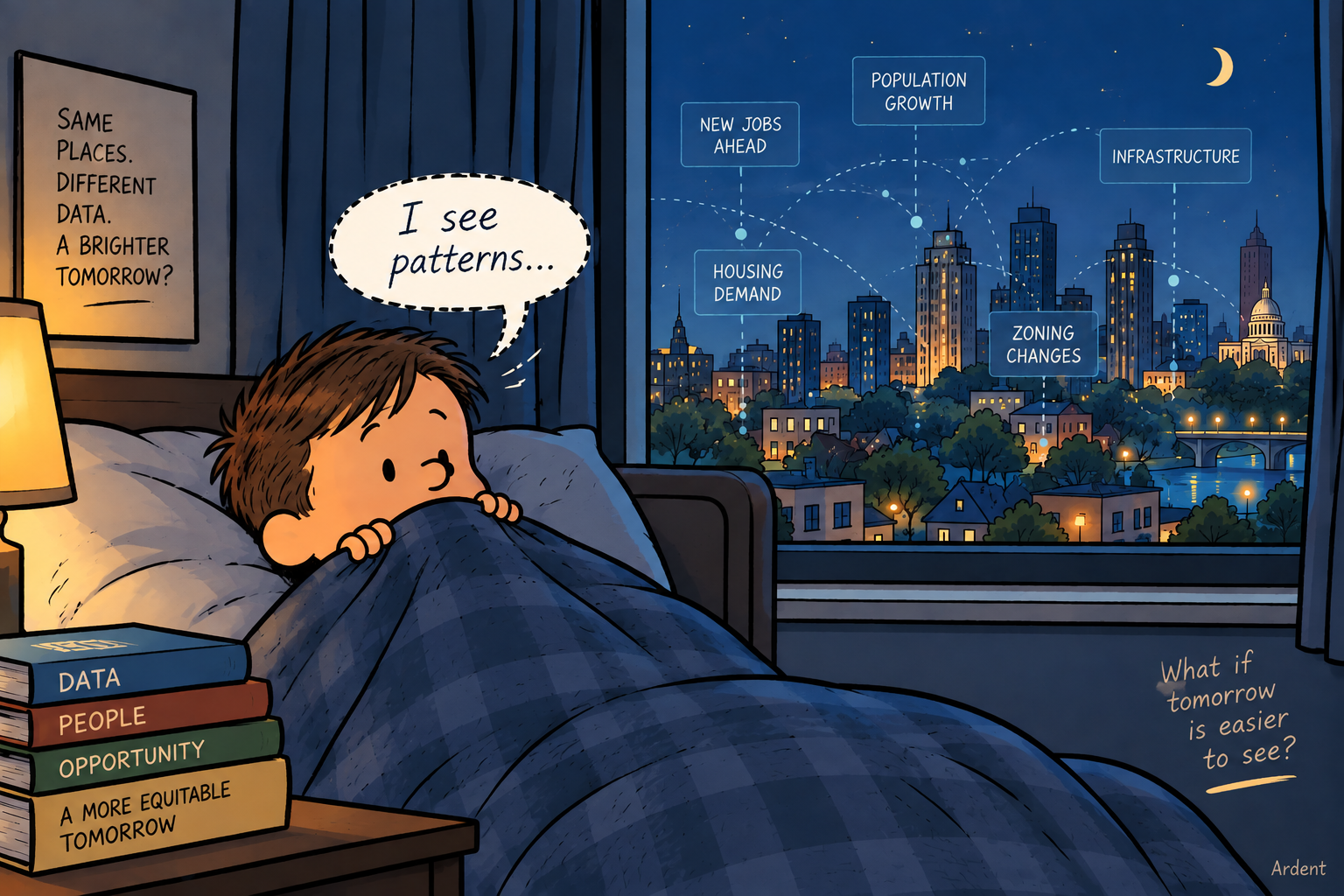
I have been thinking a lot lately about the amount of intelligence quietly making its way into real estate.
Not intelligence as in smarter people suddenly entered the room. We have plenty of smart people in real estate.
I mean data, artificial intelligence, predictive analytics and the ability to process an enormous amount of information at once.
Real estate has always been about information.
Who knows the market? Who knows the neighborhood? Who knows where the jobs are coming? Where rents are moving? Where infrastructure is being built? Where people are moving? Which neighborhoods are changing before everyone else notices?
For a long time, experience and instinct played a huge role in putting those pieces together.
Apparently, our gut is getting some competition.
It seems real estate is getting a much bigger brain, and this isn’t really hypothetical anymore.
In 2022, Capital One wrote about the growing role of data in commercial real estate lending. One of the things that caught my attention was how its CRE team described using large datasets to look for value in the market with specific clients in mind.
Capital One also talked about automation lowering the cost of evaluating an opportunity and allowing organizations to evaluate many more opportunities than they could before. One Capital One executive said that if owners could multiply the number of potential opportunities they considered tenfold, they would be more likely to find attractive returns.
Then in 2024, Capital One went further into how data could transform commercial real estate.
Vacancies. Rents. Cap rates. Population growth. Income. Employment. Consumer spending.
Put those data points together, Capital One said, and investors can begin identifying trends and investment ideas that might be difficult to see when the information is separated.
And Capital One isn’t alone.
JLL’s OneMapIQ brings thousands of data points together into a location-intelligence platform used for things like site selection and investment screening. JLL says the platform uses AI and big data to accelerate site-selection decisions.
None of this means a computer suddenly knows which building everyone should buy.
But I think it changes the question.
For years, we have largely asked:
What do we know about this property?
Increasingly, we may be able to ask:
What can all of this information tell us about what this property, neighborhood or city could become?
Then I started looking at who has the money, and this is where my brain started wandering.
Amazon has committed $3.6 billion through its housing fund to create or preserve more than 35,000 affordable homes in the Puget Sound, National Capital and Nashville regions. Amazon has reported more than $2.4 billion committed through the fund.
And this month, Airbnb announced something interesting.
On September 14, 2026, Airbnb launched its Housing Accelerator. The company committed an initial $250 million in what it describes as “last-dollar” financing, with the goal of helping unlock more than $5 billion in housing investment over the next ten years.
But the initiative isn’t only about money.
Airbnb also announced support for housing-policy reforms involving zoning, permitting and building codes; plans for a dataset examining housing policies and outcomes in different cities; and a $5 million Housing Innovation Prize for companies and nonprofits developing technologies intended to make housing faster, cheaper and easier to build.
So now we have capital, housing, data, technology, policy and increasingly sophisticated location intelligence all moving around the same industry.
Individually, none of that is particularly shocking.
Put it together, though, and I start asking bigger questions.
What happens when tomorrow becomes easier to see?
I want to draw a very clear line here between what is happening and where my mind goes with it.
I have not found evidence that Capital One has built some all-knowing AI model secretly identifying properties before everyone else.
I have not found evidence that Amazon is using AI to decide which affordable-housing properties to fund.
And I have not found evidence that Airbnb’s housing investments are being selected by predictive AI.
So I’m not saying those things are happening.
What we can document is that increasingly sophisticated data tools are being used to analyze real-estate markets and investment opportunities. Capital One has written about combining market and demographic data to identify investment ideas. JLL is already offering AI-assisted location intelligence. And major companies with significant capital are putting billions of dollars into housing.
That’s where the facts stop. And where my mind starts going.
What happens when these technologies become good enough to identify not just what a location is worth today, but what could make that location more valuable tomorrow?
Not certainty.
Foresight.
Buy today and hold for tomorrow.
Imagine a system looking simultaneously at employment growth, population migration, housing supply, infrastructure investment, transportation, zoning changes, rents, development pipelines and dozens—or eventually hundreds—of other signals.
Individually, we already look at many of these things.
The difference is the ability to look at all of them together, continuously, across thousands of locations.
Maybe the system notices a combination we don’t.
And essentially says:
Buy here.
If I can buy something today based on what the combined information suggests is coming tomorrow, I potentially benefit from the normal change in value over time and from the future change my intelligence anticipated before it was fully reflected in the price.
I’m not simply buying what the property is today. I’m buying what I think the location could become tomorrow—at today’s price.
Of course, the model could be wrong.
AI doesn’t get a crystal ball just because we gave the spreadsheet a much bigger brain.
But what happens if it eventually becomes good enough to be right more often than we are?
Now give that intelligence capital, and things get more complicated.
Imagine a property is worth $500,000 based on today’s market.
A traditional buyer might look at comparable sales and decide $510,000 is as far as the numbers make sense.
But another buyer has access to much deeper intelligence suggesting that this particular location has unusually strong long-term potential.
Maybe $550,000 still works for them.
Maybe $575,000 does.
Not because the property is necessarily worth that much today, but because their investment decision is partly based on what they believe the location will become.
Now imagine several sophisticated buyers identifying the same geography.
Does some of tomorrow’s expected value begin creeping into today’s price?
And if it does, what happens to the buyer who is still purchasing based primarily on today’s income, today’s interest rate and today’s comparable sales?
The smaller investor.
The first-time buyer.
The nonprofit.
The affordable-housing developer trying to preserve a property.
The community organization trying to acquire land before it disappears.
To be clear, I am not saying AI is currently driving up housing prices this way. I haven’t found evidence that supports that claim.
I’m asking what happens if predictive location intelligence becomes reliable enough that investors begin acting on future potential at scale.
Because that would be a very different housing market.
But wait. What about the person selling?
This is the question that stopped me.
If the buyer can increasingly understand tomorrow’s potential, who is making sure the seller can see it too?
Imagine that same $500,000 property.
Someone offers the homeowner $550,000.
That’s a great offer based on everything the homeowner can see.
But what if the buyer’s intelligence is telling them something the homeowner doesn’t know?
Maybe infrastructure is coming.
Maybe employment patterns are shifting.
Maybe zoning is changing.
Maybe several small signals, none particularly meaningful on their own, become meaningful when analyzed together.
The seller sees what the property is worth today.
The buyer sees what the property might be worth tomorrow.
That creates an entirely different kind of information advantage.
Maybe sellers eventually need their own version of the crystal ball.
And then, of course, my mind goes to affordable housing.
I’ve spent much of my career working inside affordable housing, where information is often spread across regulatory systems, property operations, market data, resident information, financing structures and government programs.
It is a complicated industry.
And it isn’t exactly known for moving at lightning speed.
I don’t think affordable housing should fear better intelligence.
I think we should want access to it.
What if affordable-housing organizations could identify neighborhoods where rent burden is likely to increase before displacement accelerates?
What if preservation groups could identify properties at risk earlier?
What if developers could see where affordable housing will be needed five or ten years from now rather than reacting after the shortage is already obvious?
What if municipalities could evaluate a developer’s proposal with intelligence comparable to the intelligence the developer brings to the table?
Some of these capabilities already exist individually. What interests me is what happens as the information becomes easier to connect.
Which brings me to what may actually be the bigger question: who gets the intelligence?
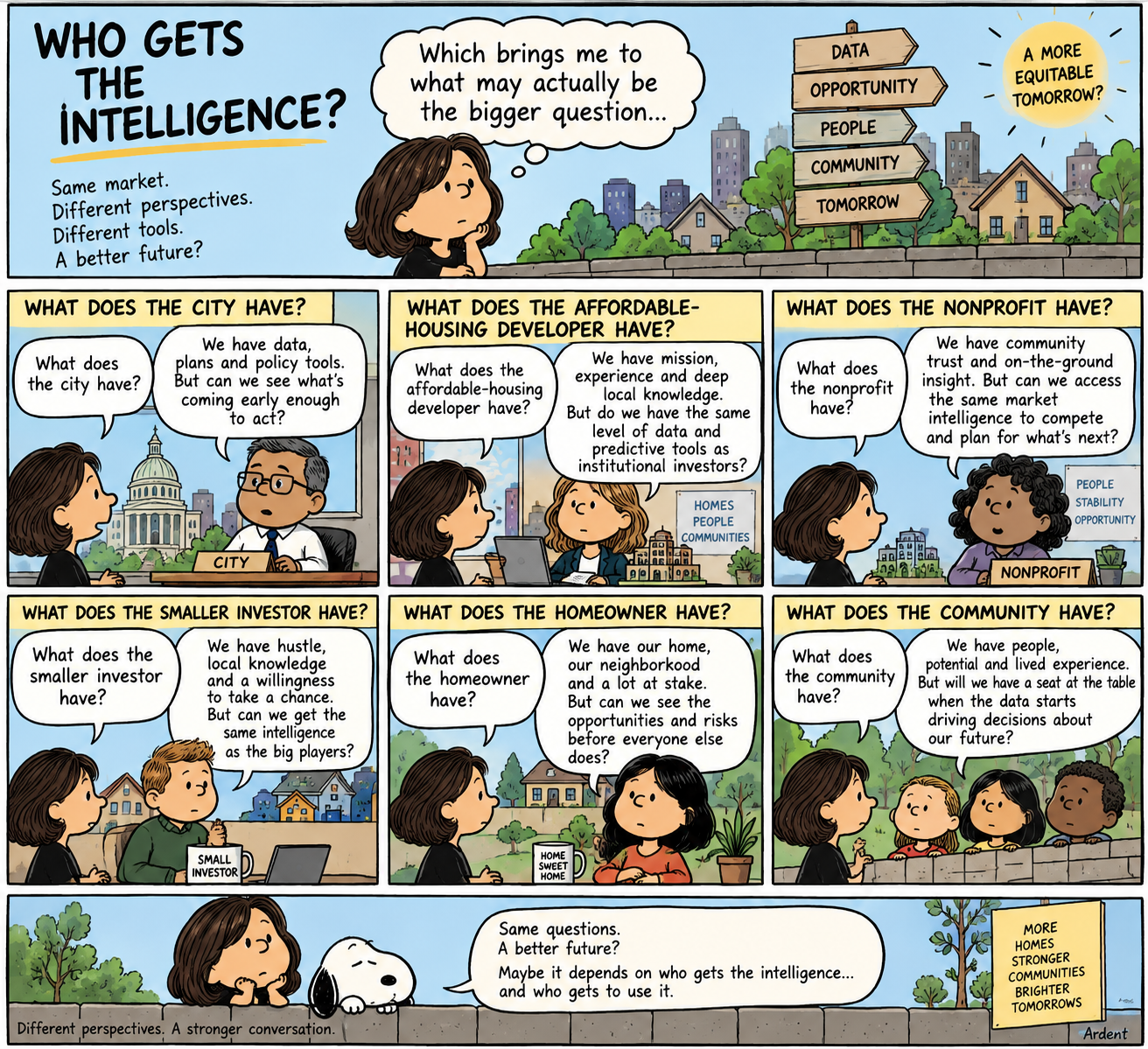
Because there is a difference between having access to data and having the ability to turn that data into intelligence.
And there may eventually be an even bigger difference between having intelligence and having enough capital to act on it.
Maybe AI democratizes real-estate intelligence.
Maybe tools that once required institutional research teams become available to a homeowner sitting at the kitchen table.
I hope that’s where this goes.
But I think we also have to consider the other possibility.
What if the organizations with the greatest ability to see tomorrow are also the organizations with the greatest ability to buy it today?
That doesn’t automatically make those organizations the bad guys.
It does mean the rest of us should probably be thinking about this now.
Not after the technology is already built.
Real estate will still be about location.
But we’re adding another layer: the ability to recognize patterns, risk, demand and connections earlier than we could before.
That could create tremendous opportunity.
It could help us build smarter.
Preserve housing earlier.
Make better investments.
Help cities plan rather than react.
Maybe even give ordinary property owners access to information that historically belonged mostly to sophisticated investors.
But it could also create a new divide.
Those who can see what’s coming.
And those who can’t.
Which brings me back to where I started.
What happens when real estate starts thinking?
Maybe the more important question is:
Who gets to think with it?
ARDENT SERIES
Who Will Shape the Next Real Estate Market?
An ongoing exploration of how data, AI, capital and institutional intelligence could change where we build, what we build, what we pay—and who has the opportunity to participate.
Some of what we’ll explore is already happening. Some of it is where I think the pieces could lead.
Knowing the difference matters.
Next in the series → What If the Seller Had the Same Crystal Ball?
Sources & Further Reading
Capital One — How Better Data Sources Create Opportunities in CRE Lending
Capital One — Commercial Real Estate Data and Insights
JLL — OneMapIQ Location Intelligence
Amazon — Housing Fund and Affordable-Housing Commitments
Airbnb — Housing Accelerator Announcement
What are you seeing?
The best ideas usually get better when they’re challenged.
If this sparked a question, a different perspective or an idea worth exploring, I’d like to hear it.
The sections discussing future predictive intelligence, future-value pricing, buyer/seller information asymmetry and possible effects on housing acquisition are exploratory scenarios. They are questions about where current capabilities could lead—not claims that those outcomes are occurring today.

